


 +972 52-548-6969



I started RavenDB in a spare bedroom, because of a problem that wouldn't let me sleep. Everywhere I looked, applications were fighting their own database. ORMs papering over a model that didn't fit. Indexes missing or just bolted on after production failures, without attention or concern to how to do this properly.
That was the common situation in the industry; accepted because databases required a lot of expertise and no one had time to do the right thing with the next release date looming. The industry's answer was always another layer of tooling on top of a design that was already wrong. So I built a database where those things were expected, that would behave properly even if it didn’t have a full time babysitter to make sure it survived production.
Twenty years later, I'm looking at the same shape of problem again.
The same feeling, a second time
In the past couple of years, we built RavenDB's AI capabilities and we've spent the last year helping our customers launch complex AI initiatives. Not just the sorts that make for a cute demo. Stuff that runs in production and intelligently serves hundreds of thousands of users. The kind that has to work in the field, in front of real users, and just keep ticking.
Looking at the overall AI landscape, I think we, as an industry, have a problem. I have not seen this much effort spent on bringing so little value since 2008. That is the sort of thing that makes my fingers itch to go ahead and fix it.
The numbers say the same thing. Demos are easy, and a weekend gets you something that impresses the room. Getting that same thing into production takes 12 to 18 months of plumbing work and endless testing, and out of a hundred initiatives, about five make it.
“Gartner expects more than 40% of agentic AI projects to be canceled by the end of 2027, citing escalating costs, unclear business value, and inadequate risk controls”
Most enterprises have their data sitting in existing systems and databases. All of them have been running for a decade or more. The entire company relies on those systems, very few people actually understand how they work and their internal interactions. Nobody is volunteering to touch them. The phrase “there be dragons” was coined specifically for those kinds of situations.
At the same time, there is an intense pressure from the market and management to introduce AI in all things. That typically means that you need to bring in new AI-ready infrastructure. Modifying the core systems of the business is tricky. No wonder that those projects take so long, or fail so often.
Remember, it's not just one system either. Working out a customer's status at a bank means the checking balance from one system, the mortgage from another, the credit card activity from a third. You also have to consider the interactions between all those systems. To bring that to the world of AI is a huge leap.
The gap you have to cross is beyond just throwing data at a Large Language Model. It's a data organization, understanding, and governance one. You have to first get your house in order before you can take the first real step.
So we built Quill
Quill is an AI Context Layer. It sits between your existing databases you already run and it provides the AI infrastructure that you need to build sophisticated AI capabilities in your organization.
Quill takes upon itself to do the work most teams are currently doing by hand.
A typical AI project requires you to first get your data governance story in order, understand how to effectively utilize Large Language Models and keep chasing the latest innovations. That previous statement, translated to calendar time, is about two years. In work-years, it is usually measured in multiple decades.
Quill changes this in a dramatic fashion, here is how it works, at a high level:
- Point Quill at your existing databases (Postgres, SQL Server, MariaDB, MySQL).
- Tell Quill what aspects you are interested in, and it will deal with the minutia of turning your existing data into the proper shape for AI to consume and work with.
- Describe what sort of AI capabilities you want (AI bank teller, for example), and Quill will generate that for you.
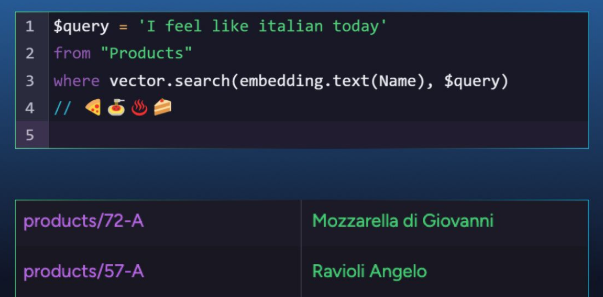
What is actually happening behind the scenes is that Quill is pulling and transforming the data from your existing databases into RavenDB. This is done on a continual basis, so the data is always up to date. Once the data is inside RavenDB, you can then apply all of RavenDB’s own AI capabilities. Such as vector search, embedding generating, Generative AI and AI Agents.
Building on top of the proven RavenDB infrastructure, you get to skip a lot of the hassles in properly delivering an AI project. Details like Bring Your Own Model, audit trails, rate limits, vector indexes and more.
Most importantly, Quill allows you to remain in control at all times. Your data never leave your servers, you don’t have to trust a cloud service with your most precious assets. You can control what information will be available to the AI model. Finally, both RavenDB and Quill take the approach that the AI model is not a trusted entity.
Typical AI projects use MCP connectors to expose your system to the AI model. That puts the AI itself in the driver’s seat. Quill takes the opposite approach, the AI is there to facilitate and provide the intelligence. It is never in control, and it is intentionally limited in what it can see and do.
Quill takes the notion of security much more seriously than merely using row-level permissions. Any interaction with the model is scoped to seeing just the information that the model should see in its current role as an agent of the user.
Quill Design Philosophy
Quill assumes that the AI model is inherently vulnerable. Quill’s approach is to limit the scope of what the AI can access and the actions it can perform. The AI is considered to be an agent of the user, not the organization.
If a user manages to prompt-engineer the AI agent, they are still behind the same security door, with no privileged access possible.
Quill’s AI capabilities allows you to immediately deploy agents in your application and in channels such as Telegram, Slack, or Discord.
What you end up with
Agents working from data that always is up to date, seeing only what they're cleared to see, running on your own servers. That's the whole thing.
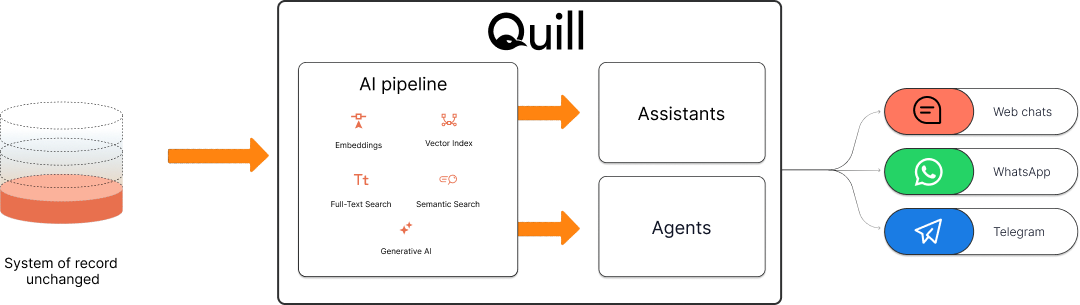
The idea with Quill is that you can rapidly AI enable your systems in a safe and reliable manner. Instead of taking years to deliver AI projects, you can be in production in mere weeks.
More importantly, Quill isn’t built to be just a nice demo. Quill was built to be the AI infrastructure that you need to scale your AI in as they grow in complexity and scale easily with a huge number of users.
Quill is built on top of RavenDB’s proven AI infrastructure. Running AI agents in production, serving hundreds of thousands of users in a highly regulated industry.
I spoke earlier about the ease of onboarding. Just point Quill to your existing databases, click “Next” a few times and you have a running AI agent that you can immediately start working with. Quill matters because it is there to handle all of the logistics around that, and all the “-ities” that you need to concern yourself with.
From built-in memory so your agents retain continuity between interactions, to audit trail so you can see past conversation, handling compaction, guardrails, mutli-agents and multi-channel conversations.
Quill allows you to build a simple AI assistant that can access the relevant data to answer questions. You can then expand on that to build sophisticated AI agents that take actions on behalf of the user.
You have the space and ability to grow your AI capabilities in an iterative manner, without having to invest several work-years into a project with high probability of failure. We are confident that you’ll be able to go from zero to production deployed AI capabilities within weeks. Quill is offered with a 3 months unlimited free trial.
Quill is generally available today. Go build your first agent now.