Oren Eini

CEO of RavenDB

a NoSQL Open Source Document Database

Get in touch with me:

oren@ravendb.net +972 52-548-6969

Posts: 7,640
|
Comments: 51,264
Privacy Policy · Terms
filter by tags archive
time to read 3 min | 538 words

Can you figure out a way to write the following code without using a try/catch?

class Program
{
    static void Main(string[] args)
    {
        dynamic e = new ExpandoObject();
        e.Name = "Ayende";

        Console.WriteLine(HasProperty("Name", e));
        Console.WriteLine(HasProperty("Id", e));
    }

    private static bool HasProperty(string name, IDynamicMetaObjectProvider dyn)
    {
        try
        {
            var callSite =
                CallSite<Func<CallSite, object, object>>.Create(
                    Binder.GetMember(CSharpBinderFlags.None, name, typeof (Program),
                                     new[]
                                     {
                                         CSharpArgumentInfo.Create(
                                             CSharpArgumentInfoFlags.None, null)
                                     }));
            callSite.Target(callSite, dyn);
            return true;
        }
        catch (RuntimeBinderException)
        {

            return false;
        }
    }
}

The HasProperty method should accept any IDynamicMetaObjectProvider implementation, not just ExpandoObject.

time to read 5 min | 827 words

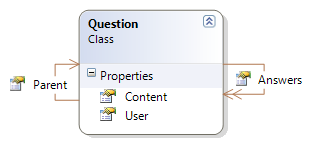
The question pops up frequently enough and is interesting enough for a post. How do you store a data structure like this in Raven?

The problem here is that we don’t have enough information about the problem to actually give an answer. That is because when we think of how we should model the data, we also need to consider how it is going to be accessed. In more precise terms, we need to define what is the aggregate root of the data in question.

Let us take the following two examples:

image image

As you can imagine, a Person is an aggregate root. It can stand on its own. I would typically store a Person in Raven using one of two approaches:

Bare references Denormalized References
{
  "Name": "Ayende",
  "Email": "Ayende@ayende.com",
  "Parent": "people/18",
  "Children": [
        "people/59",
        "people/29"
  ]
}
{
  "Name": "Ayende",
  "Email": "Ayende@ayende.com",
  "Parent": { "Name": "Oren", "Id": "people/18"},
  "Children": [
        { "Name": "Raven", "Id": "people/59"},
        { "Name": "Rhino", "Id": "people/29"}
  ]
}

The first option is bare references, just holding the id of the associated document. This is useful if I only need to reference the data very rarely. If, however, (as is common), I need to also show some data from the associated documents, it is generally better to use denormalized references, which keep the data that we need to deal with from the associated document embedded inside the aggregate.

But the same approach wouldn’t work for Questions. In the Question model, we have utilized the same data structure to hold both the question and the answer. This sort of double utilization is pretty common, unfortunately. For example, you can see it being used in StackOverflow, where both Questions & Answers are stored as posts.

The problem from a design perspective is that in this case a Question is not a root aggregate in the same sense that a Person is. A Question is a root aggregate if it is an actual question, not if it is a Question instance that holds the answer to another question. I would model this using:

{
   "Content": "How to model relations in RavenDB?",
   "User": "users/1738",
   "Answers" : [
      {"Content": "You can use.. ", "User": "users/92" },
      {"Content": "Or you might...", "User": "users/94" },
   ]
}

In this case, we are embedding the children directly inside the root document.

So I am afraid that the answer to that question is: it depends.

time to read 8 min | 1401 words

This is just some rambling about the way the economy works, it has nothing to do with tech or programming. I just had to sit down recently and do the math, and I am pretty annoyed by it.

The best description of how the economy works that I ever heard was in a Terry Prachett’s book, it is called Captain Vimes’ Boots’ Theory of Money. Stated simply, it goes like this.

A good pair of boots costs 50$, and they last for 10 years and keep your feet warm. A bad pair of boots costs 10$ and last only a year or two. After 10 years, the poor boots cost twice as much as the good boots, and your feet are still cold!

The sad part about that is that this theory is quite true. Let me outline two real world examples (from Israel, numbers are in Shekels).

Buying a car is expensive, so a lot of people opts for a leasing option. Here are the numbers associated with this (real world numbers):

  Buying car outright Leasing
Upfront payment 120,000

42,094.31

Monthly payment (36 payments) 0

1,435.32

Buying the car (after 3 yrs) [optional] 0

52,039.67

The nice part of going with a leasing contract is that you need so much less upfront money, and the payments are pretty low. The problem starts when you try to compare costs on more than just how much money you are paying out of pocket. We only have to spent a third.

Let us see what is going to happen in three years time, when we wan to switch to a new car.

  Buying car outright Leasing
Upfront payment 120,000.00

42,094.31

Total payments 0.00

51,671.52

Selling the car -80,000.00

0.00

Total cost 40,000.00 93,765.83

With the upfront payment, we can actually sell the car to recoup some of our initial investment. With the leasing option, at the end of the three years, you are out 93,765.83 and have nothing to show for it.

Total cost of ownership for the leasing option is over twice as much as the upfront payment option.

Buying an apartment is usually one of the biggest expenses that most people do in their life. The cost of an apartment/house in Israel is typically over a decade of a person’ salary. Israel’s real estate is in a funky state at the moment, being one of the only places in the world where the prices keep going up. Here are some real numbers:

  • Avg. salary in Israel: 8,611
  • Avg. price of an apartment (in central Israel): 1,071,900

It isn’t surprising that most people requires a mortgage to buy a place to live.

Let us say that we are talking about a 1,000,000 price, just to make the math simpler, and that we have 400,000 available for the down payment. Let us further say that we got a good interest rate of the 600,000 mortgage of 2% (if you take more than 60% of the money you are penalized with higher interest rate in Israel).

Assuming fixed interest rate and no inflation, you will need to pay 3,035 for 20 years. But a 2% interest rate looks pretty good, right? It sounds pretty low.

Except over 20 years, you’ll actually pay: 728,400 back on your 600,000 loan, which means that the bank get 128,400 more than it gave you.

The bank gets back 21.4% more money. With a more realistic 3% interest rate, you’ll pay back 33% more over the lifetime of the loan. And that is ignoring inflation. Assume (pretty low) 2% per year, you would pay 49% more to the bank in 2% interest rate and 65% more in 3% interest rate.

Just for the fun factor, let us say that you rent, instead. And assume further that you rent for the same price of the monthly mortgage payment. We get:


Mortgage

Rent
Upfront payment 400,000.00 0.00
Monthly payment 3,000.00 3,000.00
Total payments (20 years) 720,000.00 720,000.00
Total money out 1,120,000.00 720,000.00
House value 1,000,000.00 0.00
Total cost 120,000.00 720,000.00

After 20 years, renting cost 720,000. Buying a house costs 120,000.  And yes, I am ignoring a lot of factors here, that is intentional. This isn’t a buy vs. rent column, it is a cost of money post.

But after spending all this time doing the numbers, it all comes back to Vimes’ Boots theory of money.


FUTURE POSTS

No future posts left, oh my!

RECENT SERIES

  1. API Design (10):
    29 Jan 2026 - Don't try to guess
  2. Recording (20):
    05 Dec 2025 - Build AI that understands your business
  3. Webinar (8):
    16 Sep 2025 - Building AI Agents in RavenDB
  4. RavenDB 7.1 (7):
    11 Jul 2025 - The Gen AI release
  5. Production postmorterm (2):
    11 Jun 2025 - The rookie server's untimely promotion
View all series

Syndication

Main feed ... ...
Comments feed   ... ...