



 +972 52-548-6969



One of the things that I began doing since starting to work on multiple OR/M Profilers is to compare how all of them are handling a particular task. This is by no means a comparative analysis, but it is an interesting data point.
The scenario in question is loading a blog with all its posts and comments.
Let us start with NHibernate:
var blogs = s.CreateQuery(
    @"from Blog b
        left join fetch b.Posts p
        left join fetch p.Comments
    where b.Id = :id")
    .SetParameter("id", 1)
    .List<Blog>();
Will generate the following SQL
select blog0_.Id             as Id7_0_,
       posts1_.Id            as Id0_1_,
       comments2_.Id         as Id2_2_,
       blog0_.Title          as Title7_0_,
       blog0_.Subtitle       as Subtitle7_0_,
       blog0_.AllowsComments as AllowsCo4_7_0_,
       blog0_.CreatedAt      as CreatedAt7_0_,
       posts1_.Title         as Title0_1_,
       posts1_.Text          as Text0_1_,
       posts1_.PostedAt      as PostedAt0_1_,
       posts1_.BlogId        as BlogId0_1_,
       posts1_.UserId        as UserId0_1_,
       posts1_.BlogId        as BlogId0__,
       posts1_.Id            as Id0__,
       comments2_.Name       as Name2_2_,
       comments2_.Email      as Email2_2_,
       comments2_.HomePage   as HomePage2_2_,
       comments2_.Ip         as Ip2_2_,
       comments2_.Text       as Text2_2_,
       comments2_.PostId     as PostId2_2_,
       comments2_.PostId     as PostId1__,
       comments2_.Id         as Id1__
from   Blogs blog0_
       left outer join Posts posts1_
         on blog0_.Id = posts1_.BlogId
       left outer join Comments comments2_
         on posts1_.Id = comments2_.PostId
where  blog0_.Id = 1 /* @p0 */
This result in a fairly simple query plan:
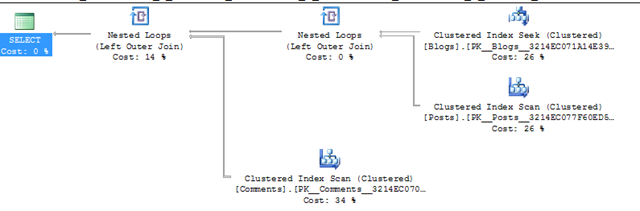
However, you should note that this also result in a Cartesian product, which may not be what you wanted.
Linq to SQL doesn’t really provide a good way to express what I wanted, but it does get the job done:
var dataLoadOptions = new DataLoadOptions();
dataLoadOptions.LoadWith<Blog>(x => x.Posts);
dataLoadOptions.LoadWith<Post>(x => x.Comments);
using (var db = new BlogModelDataContext(conStr)
{
    LoadOptions =  dataLoadOptions
})
{
    db.Blogs.Where(x => x.Id == 1).ToList();
}
Interestingly enough, this does not generate a single query, but two queries:
-- statement #1
SELECT [t0].[Id],
       [t0].[Title],
       [t0].[Subtitle],
       [t0].[AllowsComments],
       [t0].[CreatedAt]
FROM   [dbo].[Blogs] AS [t0]
WHERE  [t0].[Id] = 1 /* @p0 */

-- statement #2
SELECT   [t0].[Id],
         [t0].[Title],
         [t0].[Text],
         [t0].[PostedAt],
         [t0].[BlogId],
         [t0].[UserId],
         [t1].[Id]       AS [Id2],
         [t1].[Name],
         [t1].[Email],
         [t1].[HomePage],
         [t1].[Ip],
         [t1].[Text]     AS [Text2],
         [t1].[PostId],
         (SELECT COUNT(* )
          FROM   [dbo].[Comments] AS [t2]
          WHERE  [t2].[PostId] = [t0].[Id]) AS [value]
FROM     [dbo].[Posts] AS [t0]
         LEFT OUTER JOIN [dbo].[Comments] AS [t1]
           ON [t1].[PostId] = [t0].[Id]
WHERE    [t0].[BlogId] = 1 /* @x1 */
ORDER BY [t0].[Id],
         [t1].[Id]
The interesting bit is that while there are two queries here, this method does not generate a Cartesian product, so I have to consider this a plus. What I would like to know is whatever this is intentionally so or just a result of the way Linq to SQL eager loading is structured.
The query plan for this is simple as well:

Finally, Entity Framework (both 3.5 and 4.0), using this code:
db.Blogs
    .Include("Posts")
    .Include("Posts.Comments")
    .Where(x => x.Id == 1)
    .ToList();
This code will generate:
SELECT   [Project2].[Id]             AS [Id],
         [Project2].[Title]          AS [Title],
         [Project2].[Subtitle]       AS [Subtitle],
         [Project2].[AllowsComments] AS [AllowsComments],
         [Project2].[CreatedAt]      AS [CreatedAt],
         [Project2].[C1]             AS [C1],
         [Project2].[C4]             AS [C2],
         [Project2].[Id1]            AS [Id1],
         [Project2].[Title1]         AS [Title1],
         [Project2].[Text]           AS [Text],
         [Project2].[PostedAt]       AS [PostedAt],
         [Project2].[BlogId]         AS [BlogId],
         [Project2].[UserId]         AS [UserId],
         [Project2].[C3]             AS [C3],
         [Project2].[C2]             AS [C4],
         [Project2].[Id2]            AS [Id2],
         [Project2].[Name]           AS [Name],
         [Project2].[Email]          AS [Email],
         [Project2].[HomePage]       AS [HomePage],
         [Project2].[Ip]             AS [Ip],
         [Project2].[Text1]          AS [Text1],
         [Project2].[PostId]         AS [PostId]
FROM     (SELECT [Extent1].[Id]             AS [Id],
                 [Extent1].[Title]          AS [Title],
                 [Extent1].[Subtitle]       AS [Subtitle],
                 [Extent1].[AllowsComments] AS [AllowsComments],
                 [Extent1].[CreatedAt]      AS [CreatedAt],
                 1                          AS [C1],
                 [Project1].[Id]            AS [Id1],
                 [Project1].[Title]         AS [Title1],
                 [Project1].[Text]          AS [Text],
                 [Project1].[PostedAt]      AS [PostedAt],
                 [Project1].[BlogId]        AS [BlogId],
                 [Project1].[UserId]        AS [UserId],
                 [Project1].[Id1]           AS [Id2],
                 [Project1].[Name]          AS [Name],
                 [Project1].[Email]         AS [Email],
                 [Project1].[HomePage]      AS [HomePage],
                 [Project1].[Ip]            AS [Ip],
                 [Project1].[Text1]         AS [Text1],
                 [Project1].[PostId]        AS [PostId],
                 CASE
                   WHEN ([Project1].[C1] IS NULL) THEN CAST(NULL AS int)
                   ELSE CASE
                          WHEN ([Project1].[Id1] IS NULL) THEN CAST(NULL AS int)
                          ELSE 1
                        END
                 END AS [C2],
                 CASE
                   WHEN ([Project1].[C1] IS NULL) THEN CAST(NULL AS int)
                   ELSE CASE
                          WHEN ([Project1].[Id1] IS NULL) THEN CAST(NULL AS int)
                          ELSE 1
                        END
                 END AS [C3],
                 [Project1].[C1]            AS [C4]
          FROM   [dbo].[Blogs] AS [Extent1]
                 LEFT OUTER JOIN (SELECT [Extent2].[Id]       AS [Id],
                                         [Extent2].[Title]    AS [Title],
                                         [Extent2].[Text]     AS [Text],
                                         [Extent2].[PostedAt] AS [PostedAt],
                                         [Extent2].[BlogId]   AS [BlogId],
                                         [Extent2].[UserId]   AS [UserId],
                                         [Extent3].[Id]       AS [Id1],
                                         [Extent3].[Name]     AS [Name],
                                         [Extent3].[Email]    AS [Email],
                                         [Extent3].[HomePage] AS [HomePage],
                                         [Extent3].[Ip]       AS [Ip],
                                         [Extent3].[Text]     AS [Text1],
                                         [Extent3].[PostId]   AS [PostId],
                                         1                    AS [C1]
                                  FROM   [dbo].[Posts] AS [Extent2]
                                         LEFT OUTER JOIN [dbo].[Comments] AS [Extent3]
                                           ON [Extent2].[Id] = [Extent3].[PostId]) AS [Project1]
                   ON [Extent1].[Id] = [Project1].[BlogId]
          WHERE  1 = [Extent1].[Id]) AS [Project2]
ORDER BY [Project2].[Id] ASC,
         [Project2].[C4] ASC,
         [Project2].[Id1] ASC,
         [Project2].[C3] ASC
The query plan for this seems overly complicated:

If you’ll look closely, you’ll see that it generate a join between Blogs, Posts and Comments, essentially creating a Cartesian product between all three.
I am not going to offer commentary on the results, but open a discussion on them.
 I just finished listening to