



 +972 52-548-6969


time to read 1 min | 15 words
Fitzchak has all the details in our company blog.


Fitzchak has all the details in our company blog.
Because I keep getting asked, this feature is available for the following profilers:
This new feature detects a very interesting bad practice, write to the database from multiple session in the same web request.
For example, consider the following code:
public void SaveAccount(Account account)
{
    using(var session = sessionFactory.OpenSession())
    using(session.BeginTransaction())
    {
           session.SaveOrUpdate(account);
           session.Transaction.Commit();
    }
}
public Account GetAccount(int id) { using(var session = sessionFactory.OpenSession()) { return session.Get<Account>(id); } }
It is bad for several reasons, micro managing the session is just one of them, but the worst part is yet to come…
public void MakePayment(int fromAccount, int toAccount, decimal ammount)
{
    var from = Dao.GetAccount(fromAccount);
    var to = Dao.GetAccount(toAccount);
    from.Total -= amount;
    to.Total += amount;
    Dao.SaveAccount(from);
    Dao.SaveAccount(to);
}
Do you see the error here? There are actually several, let me count them:
Think about it, if the server crashed between the fifth and sixth lines of this method, where would we be?
We would be in that wonderful land where money disappear into thin air and we stare at that lovely lawsuit folder and then jump from a high window to a stormy sea.
Or, of course, you could use the profiler, which will tell you that you are doing something which should be avoided:

Isn’t that better than swimming with the sharks?
Recently, we added a way to track alerts across all the sessions the request. This alert will detect whenever you are making too many database calls in the same request.
But wait, don’t we already have that?
Yes, we do, but that was limited to the scope of one session. there is a very large set of codebases where the usage of OR/Ms is… suboptimal (in other words, they could take the most advantage of the profiler abilities to detect issues and suggest solutions to them), but because of the way they are structured, they weren’t previously detected.
What is the difference between a session and a request?
Note: I am using NHibernate terms here, but naturally this feature is shared among all profiler:
A session is the NHibernate session (or the data/object context in linq to sql / entity framework), and the request is the HTTP request or the WCF operation. If you had code such as the following:
public T GetEntity<T>(int id)
{
    using (var session = sessionFactory.OpenSession())
    {
         return session.Get<T>(id);
    }
}
This code is bad, it micro manages the session, it uses too many connections to the database, it … well, you get the point. The problem is that code that uses this code:
public IEnumerable<Friends> GetFriends(int[] friends)
{
   var results = new List<Friends>();
   foreach(var id in friends)
       results.Add(GetEnttiy<Friend>(id));

   return results;
}
The code above would look like the following in the profiler:

As you can see, each call is in a separate session, and previously, we wouldn’t have been able to detect that you have too many calls (because each call is a separate session).
Now, however, we will alert the user with a too many database calls in the same request alerts.

We have recently been doing some work on Uber Prof, mostly in the sense of a code review, and I wanted to demonstrate how easy it was to add a new feature. The problem is that we couldn’t really think of a nice feature to add that we didn’t already have.
Then we started thinking about features that aren’t there and that there wasn’t anything in Uber Prof to enable, and we reached the conclusion that one limitation we have right now is the inability to analyze your application’s behavior beyond the session’s level. But there is actually a whole set of bad practices that are there when you are using multiple sessions.
That led to the creation of a new concept the Cross Session Alert, unlike the alerts we had so far, those alerts looks at the data stream with a much broader scope, and they can analyze and detect issues that we previously couldn’t detect.
I am going to be posting extensively on some of the new features in just a bit, but in the meantime, why don’t you tell me what sort of features do you think this new concept is enabling.
And just a reminder, my architecture is based around Concepts & Features.
Originally posted at 1/7/2011
Because I keep getting asked, this feature is available for the following profilers:
This feature is actually two separate ones. The first is the profiler detecting what is the most expensive part of the query plan and making it instantly visible. As you can see, in this fairly complex query, it is this select statement that is the hot spot.
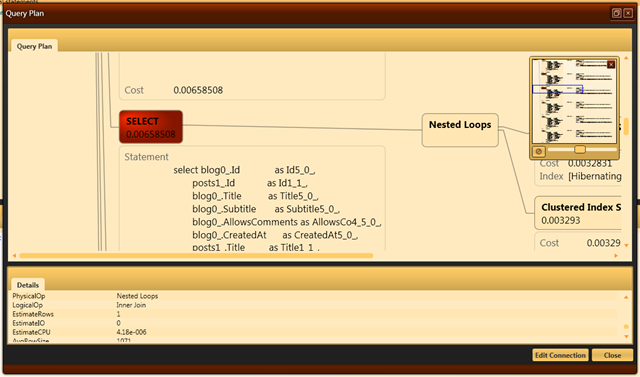
Another interesting feature that only crops up whenever we are dealing with complex query plans is that the query plan can get big. And by that I mean really big. Too big for a single screen.
Therefore, we added zooming capabilities as well as the mini map that you see in the top right corner.
Originally posted at 1/7/2011
This is another oft requested feature that we just implemented. The new feature is available for the full suite of Uber Profilers:
You can see the new feature below:

I think it is cute, and was surprisingly easy to do.
Uber Prof have recently passed the stage where it is mostly implemented using itself, so I just had to wire a few things together, and then I spent most of the time just making sure that things aligned correctly on the UI.
To celebrate the new year, I decided to offer a single day coupon that will get you 35% discount for all my profiler products.
The coupon code is valid until the 1st of January 2011, but I won’t mention in which timezone, so you might want to hurry up.
The coupon code is:
You can use it to buy:
Happy new year!
Originally posted at 11/25/2010
In a recent post, I discussed the notion of competitive advantage and how you should play around them. In this post, I am going to focus on Uber Prof. Just to clarify, when I am talking about Uber Prof, I am talking about NHibernate Profiler, Entity Framework Profiler, Linq to SQL Profiler, Hibernate Profiler and LLBLGen Profiler. Uber Prof is just a handle for me to use to talk about each of those.
So, what is the major competitive advantage that I see in the Uber Prof line of products?
Put very simply, they focus very heavily on the developer’s point of view.
Other profilers will give you the SQL that is being executed, but Uber Prof will show you the SQL and:
There are other stuff, of course, but those are the core features that make Uber Prof into what it is.
I have been doing some studying of how people are using the profiler, and it shows some interesting results.


One of the annoying things about the Hibernate port of the profiler was that JDBC didn’t provide us with the parameters values.
Eric has just fixed and that is now live:

Enjoy…
No future posts left, oh my!